How to Choose the Right Horse Pasture Seed Mix
Choosing the right horse pasture seed mix can feel overwhelming. With so many options available, it is easy to assume that the most specialised or expensive mix will produce the best results. However, successful pasture improvement is rarely about finding a “perfect” seed mix. It is about understanding what your pasture needs now and choosing seed that matches your soil, management and long-term goals.
For many horse owners, a general purpose horse pasture seed mix provides the best starting point. Specialist mixes can then be introduced later when specific conditions or objectives have been identified.

Some plant species can establish across a wide range of soils and conditions. Others are far more specific, thriving only where drainage, fertility, and management align with their needs.
In this article, we’ll refer to these as general purpose horse pasture seed mixes (broadly adaptable) and specialist horse pasture seed mixes designed for specific soil conditions.
Why Choosing a Horse Pasture Seed Mix Starts With Your Soil
When we want more forage from our pastures, it is easy to assume the next step is to apply fertiliser, reseed, or overseed with a seed mix. However, pasture systems don’t respond well to being reset without context.
Whatever your starting point, the soil needs to become functional within a balanced ecosystem to support resilient plant growth.
When soil lacks function and balance, or the wider ecosystem becomes unregulated, patterns begin to emerge. Certain plant species start to dominate, pest pressure increases, and the ground may swing between holding too much water or drying out quickly. Compaction and surface instability become more common, and over time this can lead to a growing reliance on repeated inputs.
This reduces the quality of the environment we are providing for our horses and often creates a cycle of intervention rather than long-term improvement.
So while seed choice matters, it cannot compensate for soil that is not functioning well, or for a system that has lost its balance. At the same time, plant diversity is one of the key tools that helps soil recover and maintain that function.
What Your Pasture Actually Needs First
Before choosing a seed mix, it helps to understand what your pasture is responding to.
In many cases, the limiting factors are not the absence of seed, but underlying constraints within the system itself. This might include:
Imbalanced soil biology
Inappropriate fertility levels
Compaction or reduced root function
Low species diversity
Areas of bare and exposed soil
Poor water infiltration and storage
One of the most overlooked limitations is competition pressure. Existing grasses, especially in improved pastures, can outcompete new seedlings for light, water, and nutrients. Without reducing that pressure, even well-chosen seed struggles to establish. This is why choosing a horse pasture seed mix should always come after assessing the condition of the existing pasture rather than simply adding new seed.
Until these underlying factors begin to improve, even the best seed mix will struggle to establish effectively.
If you’re unsure how to assess your soil, we cover this step by step in our soil and pasture management course, including how to identify limiting factors before investing in seed or inputs.
General Purpose Horse Pasture Seed Mixes: Where Most Pastures Should Start
A well-designed general purpose, horse-safe mix can play an important role at this stage. Rather than trying to create a finished pasture, it helps to shift the direction of the system.
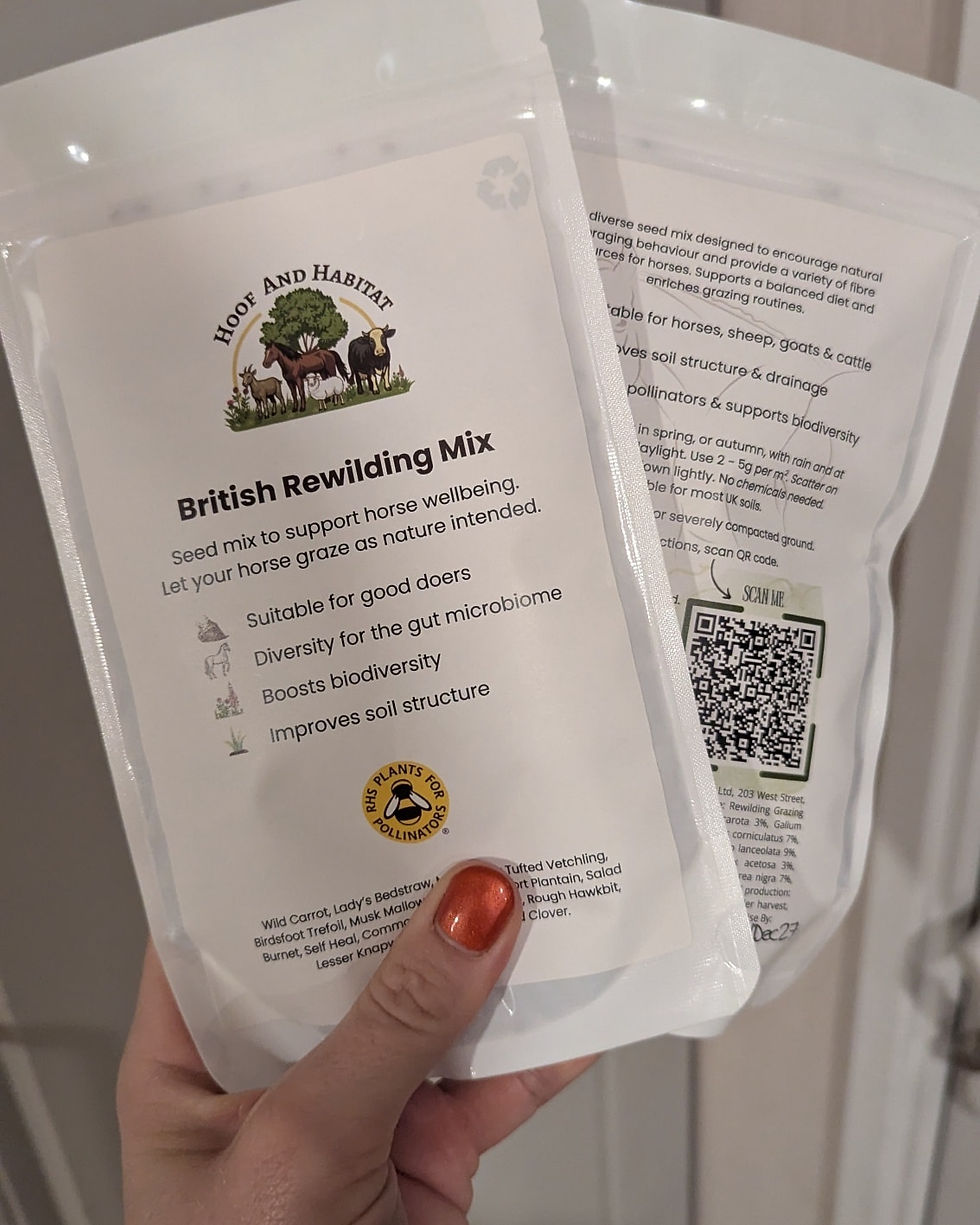
By introducing a wider range of grasses, wildflowers, herbs and legumes, these mixes begin to increase species diversity, improve ground cover, and contribute to soil structure over time. This creates a more stable base that future changes can build on.
Diversity changes the shape of nutrition, not just the quantity of it.
This is particularly relevant for horses prone to weight gain, metabolic issues, or restricted grazing, where fibre diversity matters as much as intake.
Even relatively small increases in plant diversity can start to influence how horses graze, the range of fibre entering the hindgut, and how the soil system functions. Over time, this also improves resilience to weather and grazing pressure.
For many pastures, this step alone can create meaningful improvement. Our Biodiverse Grazing Mix for Horses has been developed as a general purpose starting point for many equestrian pastures. It combines grasses, herbs, legumes and wildflowers to increase botanical diversity while supporting healthy grazing systems.
Top tip: What makes a good general purpose horse pasture seed mix?
A good general purpose mix will:
Be safe and palatable for horses
Establish across a range of soil conditions
Include a mix of root depths
Contain a proportion of herbs, wildflowers and legumes (often around 20%)
When a Specialist Horse Pasture Seed Mix Is Worth Considering
Specialist mixes can play an important role, but timing matters and they are not always needed.
Soil naturally contains a seed bank, made up of seeds from previous plant communities that remain dormant until conditions allow them to establish. As soil function improves, these seeds can begin to reappear, often restoring species that are already adapted to your land.
Where the soil seed bank has been depleted, or certain areas consistently struggle to establish, introducing specialist mixes can be effective once the system has started to stabilise and dominant species have been reduced enough to allow new plants to compete.
Specialist mixes can enhance or restore a system, but they cannot always be expected to fix one.
Top tip: What makes a good specialist horse pasture seed mix?
A specialist mix should:
Be safe and appropriate for horses
Match your soil type, climate, and conditions
Be used to target a specific goal
Soil Condition Still Determines Success
Seed choice alone does not determine outcome.
Establishment depends on whether the soil can support root development, microbial activity, moisture retention, and plant competition. Without this foundation, new seedlings are unlikely to persist.
Supporting soil function doesn’t always require intensive intervention. Often, it comes back to allowing recovery and reducing pressure. Resting overworked areas, introducing organic matter, encouraging biological activity, and limiting unnecessary disturbance can all help move the system in the right direction.
Without these changes, reseeding often becomes repetitive and expensive, with little long-term improvement, and in some cases, a gradual decline in soil structure, plant diversity, and grazing quality.
To learn more, take a look at the blog, How to Assess Your Horse Pasture Before You Spend Money
A Note on Diversity, Nutrition and Management
Species-rich pasture does not guarantee a perfectly balanced diet. However, it can shift the nutritional baseline in a positive direction by increasing fibre diversity, widening mineral exposure, and reducing reliance on uniform forage systems.
In practice, this often changes the role of supplementation. Instead of correcting major imbalances, it becomes more about fine-tuning individual requirements.
To learn more, take a look at the blog, How to Design a Horse Paddock That Supports Horses, Soil and Wildlife
A More Effective Approach
Instead of asking, “What is the best seed mix?”
It is often more useful to ask, “What does my pasture need next?”
If the goal is long-term stability, we need to support the system in becoming more self-sustaining over time.
For many pastures, the progression looks like:
Reduce ongoing negative impact
Support soil function
Introduce general, horse-safe diversity
Improve ground cover and stability
Layer in more targeted, specialist species over time (if needed)
This reduces risk, improves establishment success, and allows the pasture to respond as a system.
The Bigger Picture
Pasture is not just a feed source. It is the environment your horse lives within every day.
How it is managed influences what your horse eats, how they graze and forage, and how well they are able to express natural behaviours. It also determines how resilient the land becomes and how much input is required to maintain it over time.
Like raising a child towards independence, pasture management is about supporting the system so that it becomes more self-sufficient. We still step in when needed, but over time, a well-supported pasture becomes easier to manage, more resilient, and less reliant on repeated intervention.
Key Takeaway
You don’t need to start with the most specialised solution.
You need to start with the most appropriate step for your system. Horse-safe, functional, ecological and practical.
The real issue is not choosing the wrong seed mix. It is repeating the same cycle of disturbance, reseeding, and limited establishment, without changing the conditions the pasture is responding to.
General purpose mixes can help establish a functional baseline without needing perfect soil knowledge
Specialist mixes can be layered in as your system develops, where needed
If you are unsure where to start, understanding your soil and pasture condition will always give you a clearer direction.
Frequently Asked Questions
What is the best horse pasture seed mix?
The best horse pasture seed mix depends on your soil, climate, existing pasture and management goals. For many horse owners, a general purpose mix containing a range of grasses, legumes and herbs is the best starting point because it improves diversity without requiring perfect soil knowledge.
Should I choose a specialist or general purpose horse pasture seed mix?
A general purpose mix is usually the best first step when you want to increase pasture diversity and resilience. Specialist mixes are most useful when you have a clear objective, such as matching a specific soil type or restoring a particular habitat.
Can I overseed an existing horse pasture?
Yes. Overseeding can increase plant diversity where existing pasture is still functioning. However, successful establishment depends on reducing competition from existing plants, improving soil conditions and providing enough opportunity for seedlings to establish.
Why does my horse pasture seed not grow?
Seed failure is often caused by factors other than the seed itself. Compaction, poor soil structure, competition from existing plants, incorrect timing or insufficient soil contact can all reduce establishment.
Do horse pastures need specialist wildflower mixes?
Not always. Many horse owners benefit most from first establishing a diverse, resilient grazing system. Specialist wildflower mixes can then be used strategically where conditions and goals are suitable.
Next Step
If you’re unsure where your pasture sits or what to do next, start by learning how to read your soil and grazing system.
Our courses are designed to help you make these decisions with confidence before investing in seed, inputs, or machinery.
For those who want more tailored support, consultations are also available via phone or video. To arrange a booking, please email info@hoofandhabitat.co.uk.


Comments